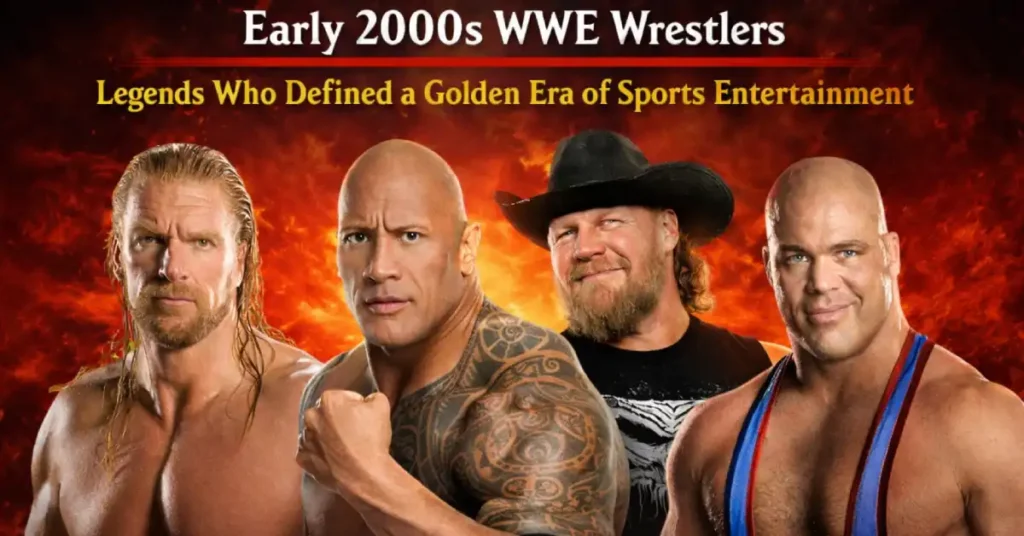
The early 2000s marked one of the most exciting and transformative periods in professional wrestling history. WWE transitioned from the Attitude Era into what became known as the Ruthless Aggression Era, introducing a new generation of superstars while elevating established icons. 2000s WWE Wrestlers delivered unforgettable matches, intense rivalries, and characters that still influence WWE today.
This era blended raw athleticism, larger-than-life personalities, and evolving storytelling. Fans witnessed the rise of future Hall of Famers, brutal championship battles, and the global expansion of WWE’s brand. In this article, we take a deep dive into the most influential Early 2000s WWE Superstars, their legacies, and why this era remains so beloved.
Related Read: Most Famous WWE Wrestlers
Table of Contents
The Ruthless Aggression Era Explained
In 2002, WWE officially launched the Ruthless Aggression Era following the brand split between Raw and SmackDown. This move allowed WWE to showcase more talent, create fresh storylines, and push rising stars into main-event roles. The 2000s WWE Wrestlers during this period were defined by intense in-ring styles, realism, and a stronger focus on championship credibility.
This era was less cartoonish than the late 1990s and more aggressive in tone, appealing to fans who craved realism mixed with entertainment.
Top Early 2000s WWE Wrestlers Who Ruled the Era
Triple H – The Cerebral Assassin
Triple H dominated the early 2000s like few others. As a multiple-time World Heavyweight Champion, he carried Raw and played a key role in mentoring younger talent. His feuds with Shawn Michaels, Booker T, and Chris Benoit helped define the championship scene for Early 2000s WWE Superstars.
The Rock – Hollywood Star with WWE Roots
Although The Rock began transitioning to Hollywood, his presence in the early 2000s remained massive. Matches against Hulk Hogan, Brock Lesnar, and Stone Cold Steve Austin delivered some of the biggest moments in WWE history. Among Early-2000s wrestling icons, The Rock’s charisma was unmatched.
Stone Cold Steve Austin – The Final Run
Stone Cold’s early 2000s run featured iconic matches, including his final bout at WrestleMania XIX. Even as his in-ring career wound down, Austin’s popularity remained sky-high, proving why he is forever linked with the most influential 2000s-era WWE legends.
Brock Lesnar – The Next Big Thing
Brock Lesnar debuted in 2002 and instantly became a dominant force. Winning the WWE Championship at just 25 years old, Lesnar brought a legitimate combat sports feel. His rise symbolized the evolution of Early 2000s WWE Superstars toward realism and power.
John Cena – From Prototype to Franchise Player
John Cena’s initial hip-hop–inspired character quickly connected with younger fans and helped him stand out early in his WWE career. By the mid-2000s, he became WWE’s top star. His journey from rookie to champion highlights the long-term storytelling that defined 2000s-era WWE legends.
Kurt Angle – Athletic Excellence Personified
Kurt Angle combined Olympic-level wrestling with incredible mic skills. His feuds with Brock Lesnar, Chris Benoit, and Eddie Guerrero produced some of the best technical matches of the era. Angle stands tall among elite Early 2000s WWE Superstars.
Eddie Guerrero – Lie, Cheat, Steal
Eddie Guerrero’s emotional rise to WWE Champion in 2004 is one of the most inspiring stories in wrestling history. His connection with fans and in-ring mastery made him a cornerstone of 2000s-era WWE legends.
Batista – The Animal Unleashed
Batista’s evolution from Evolution’s enforcer to World Heavyweight Champion defined SmackDown in the mid-2000s. His rivalry with Triple H elevated him into superstardom, cementing his legacy among 2000s WWE Wrestlers.
Rey Mysterio – The Ultimate Underdog
Rey Mysterio brought lucha libre style to the mainstream. His 2006 Royal Rumble win and World Championship reign proved that size didn’t matter. Among 2000s WWE Wrestlers, Rey redefined what a champion could look like.
Tag Team Wrestling in the Early 2000s
The tag team division also thrived during this era. Tag teams such as Edge & Christian, The Hardy Boyz, and The Dudley Boyz completely transformed ladder matches and made TLC contests a defining attraction of the era. These teams played a crucial role in making Early 2000s WWE Superstars must-watch performers every week.
Women’s Division Growth
While still limited compared to today, the early 2000s women’s division featured stars like Trish Stratus, Lita, and Victoria. Their athleticism and storytelling laid the foundation for the Women’s Evolution, adding depth to the era of 2000s WWE Wrestlers.
Championship Prestige and Storytelling
World titles felt meaningful in the early 2000s. Long-term rivalries, emotional payoffs, and character development defined the booking. The consistency helped elevate Early 2000s WWE Superstars into global superstars.
Cultural Impact of Early 2000s WWE
WWE during this time dominated pop culture, from video games and merchandise to mainstream media appearances. The influence of 2000s-era WWE legends extended far beyond the ring, shaping a generation of fans worldwide.
Why Fans Still Love the Early 2000s Era
Nostalgia plays a role, but quality storytelling and unforgettable moments are the real reasons. The balance between entertainment and athleticism made Early 2000s WWE Superstars timeless.
FAQs
Who were the most popular early 2000s WWE wrestlers?
John Cena, Triple H, Brock Lesnar, The Rock, and Eddie Guerrero were among the most popular stars.
What was the Ruthless Aggression Era?
It was WWE’s early 2000s phase focused on realism, intense matches, and new talent development.
Why are early 2000s WWE wrestlers still remembered today?
Their matches, characters, and rivalries set a standard that continues to influence WWE.
Which title was most important in the early 2000s?
Both the WWE Championship and World Heavyweight Championship held major prestige.
Did early 2000s WWE wrestlers influence modern WWE?
Yes, many current stars model their style and promos after legends from this era.
Conclusion
The early 2000s stand as one of WWE’s most influential periods. The blend of legendary veterans and rising stars created an unforgettable era filled with passion, innovation, and authenticity. 2000s-era WWE legends didn’t just entertain—they shaped the future of professional wrestling.
From iconic championships to emotional storylines, this era remains a benchmark for excellence. Whether you’re a longtime fan or a newcomer exploring WWE history, the legacy of Early 2000s WWE Superstars continues to inspire and captivate audiences worldwide.

Alex Jordan is the creator and lead author of Wrestleradar.com, where he covers wrestling news, match breakdowns, and behind-the-scenes insights with passion and detail. With a strong eye for storytelling and industry analysis, Alex delivers content that keeps wrestling fans informed, engaged, and entertained.